Owner
Every checklist item should have a person responsible for updating or approving it.
Planning tools
Templates are useful when they make a team more specific. A good worksheet should expose missing decisions, not hide them behind polished formatting.
Use this section to decide whether the topic fits the problem in front of the clinic. The most useful page is the one that helps a team say no to the wrong work.
These checks are intentionally operational. They point to things a real team can inspect, assign, and improve without pretending that rankings alone explain performance.
Every checklist item should have a person responsible for updating or approving it.
The worksheet should ask what source supports the decision: GBP, analytics, call logs, reviews, clinician input, or page audit.
Medical, advertising, privacy, and platform-policy risks should be visible before copy goes live.
A template that ends in notes is weaker than one that ends in assigned edits, review dates, or experiments.
Each template is meant to create a specific decision, not just another document.
 Checklist
 A recurring audit worksheet for local visibility and treatment-page quality.
 CTA
CTA CTA patterns for different levels of patient certainty and service complexity.
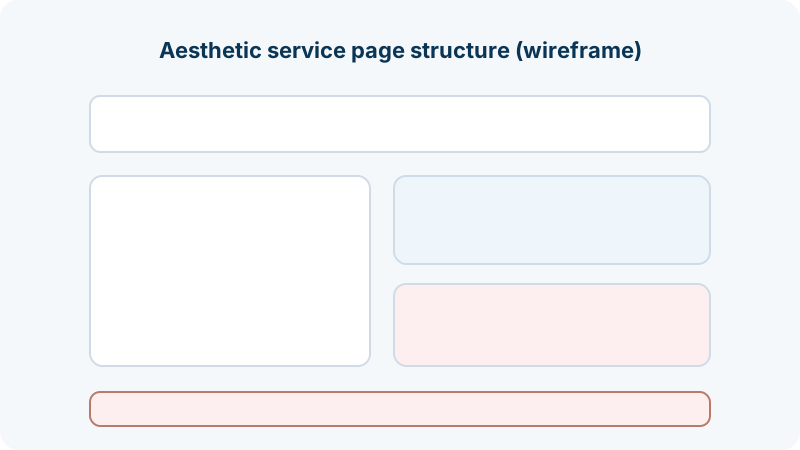 Brief
Brief A section-by-section treatment page brief for writers and reviewers.
No. They are marketing planning tools. Any public-facing claim, review response, or service description should be reviewed through the clinic’s normal compliance process.
Use the structure consistently, but fill it with clinic-specific evidence. Otherwise the output will feel generic very quickly.